

The Greatest Misconception About the Bible
And the misinterpretation that stems from it

NOTE: This article is based on objective historical data and the work of biblical scholars such as Bart Ehrman, James Tabor, Daniel McClellan, and Elaine Pagels. Most of the information presented is easily verifiable, while reliable sources are provided for lesser-known claims.

There is a popular misconception about the Bible. Although simple, it is also the greatest obstacle to a more accurate understanding of Scripture.
The widespread belief is that the Bible is one book. But it is not.
Let us repeat: the Bible is NOT one book.
And more importantly, it does not convey one message.
One Cover
The Bible is most often printed within a single cover, so we naturally tend to think of it as a single book. However, it is in fact a collection of books—a compilation, an anthology—written over a period of roughly 1,200 years. It is a body of different ancient writings, produced in different historical periods, in different genres, and with different messages. As biblical scholar Daniel McClellan put it: “The Bible is a not univocal text. [...] It does not speak with a single, consistent, and unified voice.”1
Some scholars like to describe the Bible as a “library,” but such a label is unnecessary for two reasons. First, there are more precise words for this type of book: collection, compilation, anthology. Second, we do not label as such any other similar literary collection—the Arabic One Thousand and One Nights, the Indian Mahabharata, or the Hindu Vedas. Calling the Bible a “library” grants it unnecessary exclusivity.
Although the biblical canon varies by denomination, the Roman Catholic version contains 73 books, the Protestant version 66. The most well-known English version, the King James Bible, contains approximately 800,000 words. For comparison, the average novel is made up of around 70,000.
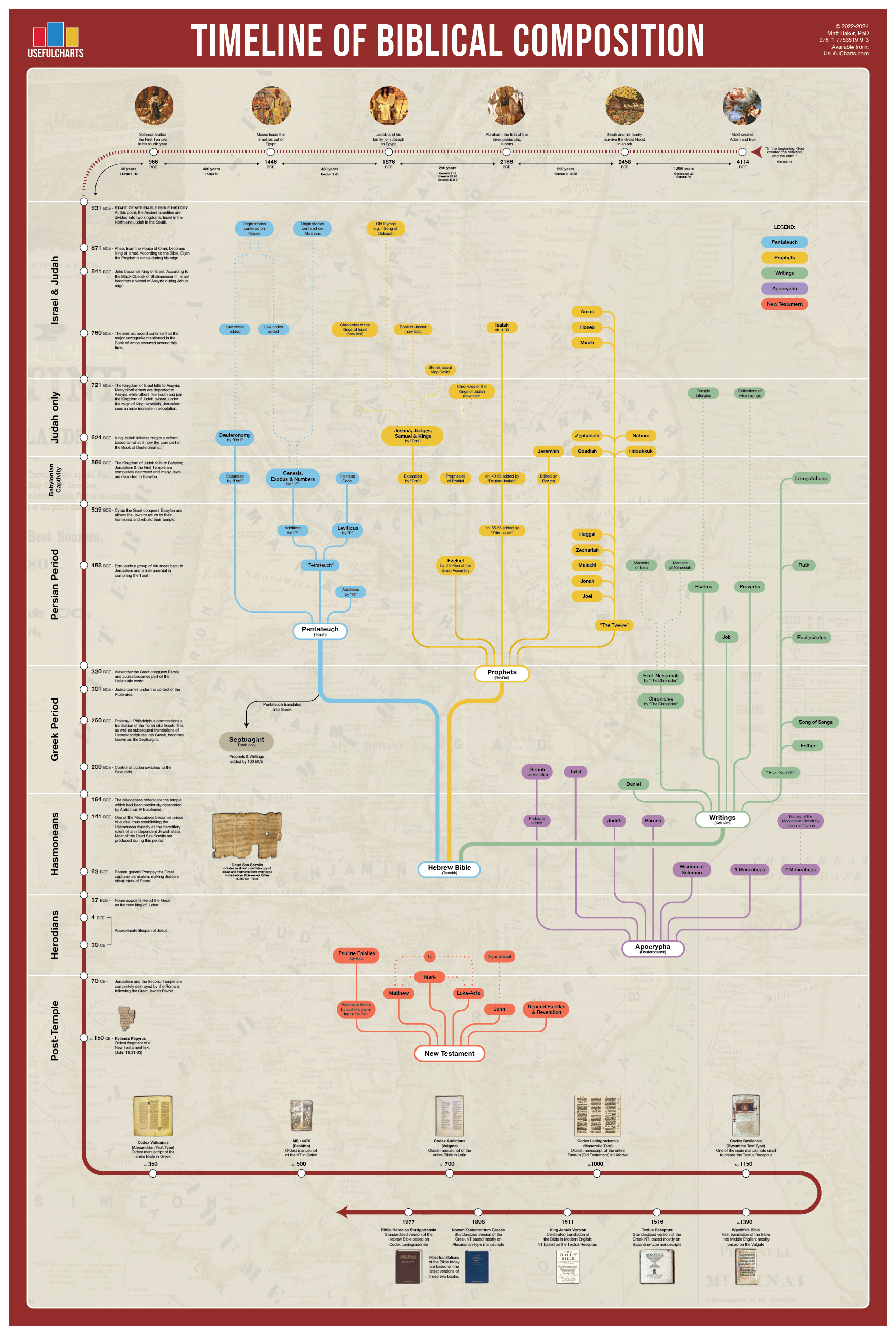
It is problematic, then, to accept arguments that the Bible is “the greatest book ever written” or “the book that has everything.” It is only expected that 70-odd books will cover a wide variety of topics. Imagine taking Beowulf (8th century), The Canterbury Tales (14th century), Romeo and Juliet (16th century), Paradise Lost (17th century), Robinson Crusoe (18th century), Oliver Twist (19th century), the Sherlock Holmes stories (19th century), Led Zeppelin lyrics (20th century), and Winston Churchill biographies (21st century), printing them as a single book, and then declaring it the greatest. That would be unfair to other books.
As is clear with the analogy, the following also holds true for the Bible: it does NOT convey one message.

No Single Message or Consistency
There is no universal interpretive key by which the Bible fully makes sense or provides consistency, as the authors who wrote these various texts had no such thing in mind. None of them even knew they were writing “the Bible.” Each was producing texts according to their own motives, perspectives, and sociopolitical contexts. The Jew who composed the framing sections of the Book of Job in Hebrew around 1000 BCE had no idea that a millennium later another writer would write the psychedelic Book of Revelation in Greek, or that a third individual would bundle everything into one collection. These two texts do not portray the same theology, the same values, or even the same god.
Consider another example. The story of Noah’s Ark is something else entirely compared to Paul’s letters. The story of the ark was written by Israelites probably around the 5th century BCE, after they had spent roughly seventy years in Babylon as slaves. Noah was written under Mesopotamian influence, with the Israelites drawing on a regional flood myth that had circulated throughout the Near East for more than a millennium, and which can be found in the earlier Epic of Gilgamesh, the Atra-Hasis, and Eridu Genesis. In Noah, the Israelite god is characterized as a merciless entity with a favorite family on Earth, willing to drown 99.9% of people and innocent animals.
On the other hand, Paul’s letters (“epistles”) were written by the Hellenized Jew Paul 600 years later (though some canonical ones are actually forgeries). They are his correspondence with Christian communities he founded throughout the Mediterranean. Paul believed that the executed Jesus was the Jewish messiah. Jesus, in turn, was a product of Jewish apocalypticism, a theological movement formed 300 years after the Babylonian captivity, and in which Jews awaited the arrival of a theological and political figure who would restore the Kingdom of Israel in God’s name, stop all wars, and bring peace to the world.
Different authorship is the source of the Bible’s inconsistency. Across its 70-odd books, it has no consistent moral framework. And this is the reason why it is so easy, for both atheists and believers, to quote a specific passage from one biblical book to prove a point, while dismissing something contradictory from another biblical book.
Explaining the Contradictions
Different authorship and different theologies explain the biblical contradictions. In the Tanakh—what Christians call the “Old Testament”—God is routinely vengeful and merciless: he orders genocides, stones people to death for gathering wood on the Sabbath, kills believers because they reflexively touched his sacred ark, allows a good man to be tormented just to prove a point, and provides instructions for slavery. Such a conception is irreconcilable with the interpretation that Jesus is God. Turning the other cheek, loving one’s enemies, forgiveness, and helping those in need are radically different ideas.
Compare just a few passages of the Old Testament God with Jesus:
“The man must die. The whole assembly must stone him outside the camp.” - Yahweh (Numbers 15:35)
“Let any one of you who is without sin be the first to throw a stone at her.” - Jesus (John 8:7)
“Show them no pity. Do not spare them or shield them. You must certainly put them to death. Your hand must be the first in putting them to death, and then the hands of all the people.” - Yahweh (Deuteronomy 13:8-9)
“Love your neighbor as yourself.” - Jesus (Matthew 22:39)
[Uzzah reached out and took hold of the Ark of the Covenant, because the oxen stumbled. The Lord killed Uzzah because of his impudent act.] - 2 Samuel 6:7
“But I tell you, do not resist an evil person. If anyone slaps you on the right cheek, turn to them the other cheek also.” - Jesus (Matthew 5:39)
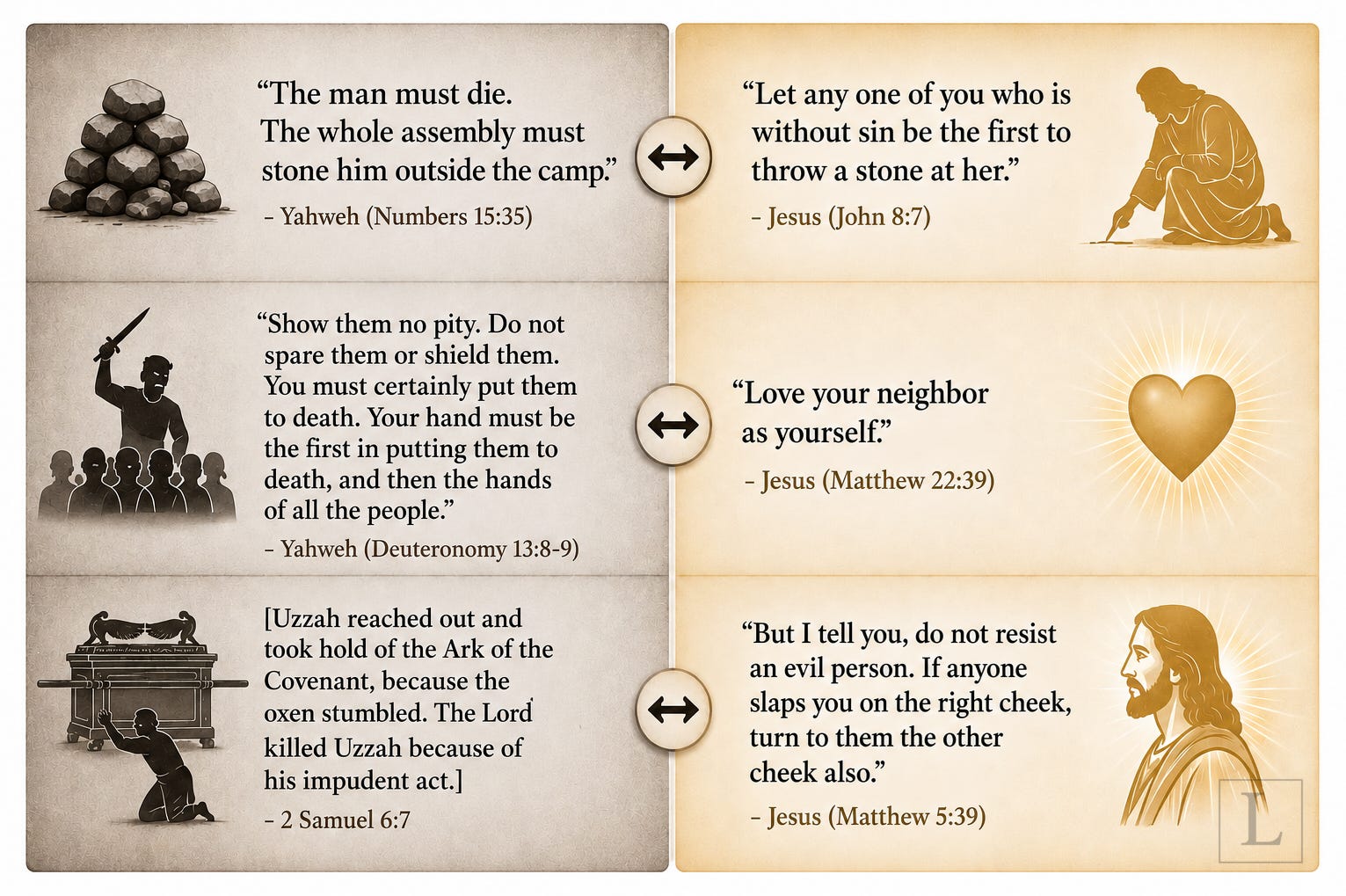
According to the Christian interpretation, this is the same character at two different points in time. But there is no need for rationalizations of this discrepancy, such as the claim that genocide became immoral only with Jesus’s arrival (moral relativism), or appeals to God’s “mysteries” (a synonym for “this makes no sense”). It is not surprising at all that even an early Christian theologian, Marcion, believed that the Old Testament Creator was an evil entity, incompatible with the good Jesus who arrived to save humanity. And we know why the texts are incompatible. They were written by different authors with different perspectives at different historical periods. The usual interpretation of the Bible is the result of asking “How do we connect these texts into a coherent whole?” rather than “Let us analyze these texts neutrally within their literary and historical context.”
Even the New Testament authors portray different versions of Jesus. For the chronologically earliest evangelist, Mark, Jesus seems to be an extraordinary individual who gets divine characteristics only after being cleansed of sin by John the Baptist. Matthew and Luke portray him as someone divine from birth, born of a virgin. For John, Jesus is not divine from his baptism or birth, but from the very beginning of the world (as the well-known logos). There are many more such examples.
In Closing
Imposing a single interpretation onto a collection of around 70 different books isn’t forbidden. Everyone is allowed to do so.
But if our goal is to explore literary history, or history in general, it is necessary to approach this collection of ancient texts with intellectual honesty, taking into account both authorship and context.
McClellan, Dan. “The Bible is Not Univocal.” youtube.com/watch?v=IuNs6voQyns. Accessed June 14, 2026.